Tata Sierra EV Comprehensive Review: The Indian automotive market is currently witnessing a renaissance. While brands are fighting over sunroofs and touchscreens, Tata Motors played a masterstroke by reviving the “Sierra” nameplate. For a 90s kid, the Sierra wasn’t just a car; it was a status symbol, an aspiration. It was the first car in India to offer that “large glass look” which felt like a private jet on wheels.
But nostalgia is a double-edged sword. When you bring back a legend, expectations are sky-high. In 2026, as the Sierra.ev prepares to dominate the roads, we must ask: Is it just a marketing gimmick using an old name, or is it a revolutionary EV?
The Design Philosophy – Aesthetic Brilliance vs. Practical Flaws
Focus on: Detailed analysis of the Curved Glass and Body Language.
The Masterpiece: That Signature Glass
The most striking feature is the Alpine Windows. Tata’s design team, led by Martin Uhlarik, has managed to keep the glass wrap-around look.
- The Pro: It offers an unparalleled view of the sky and surroundings. It makes the cabin feel twice as large as it actually is.
- The Con (The Heat Factor): Here is the “human” truth—India is not Europe. In places like Uttar Pradesh, Rajasthan, or Delhi, where temperatures hit 48°C, this glass acts like a magnifying lens. The thermal load on the Air Conditioning system will be massive. Even with UV-cut glass, the “greenhouse effect” is inevitable.
The Stance
Unlike the Curvv or the Nexon, the Sierra has a “Boxy-Sophistication.” It looks planted. However, the large 19-inch aero-wheels, while beautiful, come with a hidden cost. Replacing one tyre could cost you upwards of ₹15,000–₹20,000, a significant jump from standard SUV maintenance.
The Interior – A Living Room or a Gilded Cage?
Focus on: Luxury, Seating, and the Claustrophobia factor.
The Rear Lounge Concept
Tata is introducing a “Lounge” variant. Instead of a traditional bench, you get a wrap-around sofa.
- Human Experience: Imagine coming back from a tiring day at the office and stretching your legs in a sofa-like seat while the car glides silently. It’s luxury redefined for the ₹30 Lakh segment.
- The Critical Flaw: The windows do not open. For a country where people often suffer from motion sickness, a fixed window is a recipe for disaster. If a child feels nauseous, you cannot simply “roll down the window” for fresh air. This is a major practical drawback for family buyers.
Material Quality
Tata has used “Sustainable Materials” (recycled fabrics). While eco-friendly, they are often harder to clean than traditional leatherette. If you have kids or pets, maintaining that pristine “white/grey” lounge interior will be a full-time job.
Technical Deep Dive – Acti.ev Platform
Focus on: Range, Battery, and Charging Realities.
| Technical Metric | Promised | Real-World Expectation |
| Battery Size | 60 kWh | 58 kWh Usable |
| ARAI Range | 550 km | 380 – 410 km |
| DC Fast Charging | 10-80% in 45 min | 1 hour (due to heat throttling) |
The Sierra EV is heavy. Physics doesn’t lie. A heavier body means the motors have to work harder, especially during highway cruising. While EVs are great in cities, the Sierra’s “Range Anxiety” will be real on long trips to the mountains where charging stations are sparse.
Section 5: The “Tata Factor” – Software and Service
Focus on: After-sales, Software bugs, and Reliability.
As a police official or a government employee (like many of your readers), you value Reliability. You want a car that starts every time.
- The Buggy Software: Tata’s recent infotainment systems have been prone to “Blackouts.” In a car where almost every control (including AC) is touch-based, a screen freeze isn’t just annoying; it’s a safety hazard.
- Service Network: While Tata has the reach, the “Premium Treatment” for a ₹30 Lakh customer is still not at par with brands like Toyota or even Hyundai.
Section 6: Competitive Landscape & Final Verdict
Focus on: Comparisons with Mahindra XUV.e8 and Hyundai Creta EV.
Sierra vs. The Rivals
- Mahindra XUV.e8: Offers more raw power and a “macho” feel.
- Hyundai Creta EV: Offers better software reliability and a superior service experience.
- Sierra’s USP: It is the only one that feels like a “Boutique” car. It’s for the person who wants to be different.
SEO Summary for your Website (AdSense Approved Model)
FAQs for Google Snippets:
- What is the expected price of Tata Sierra EV? Expected between ₹24 Lakh to ₹32 Lakh depending on the battery pack.
- Does the Tata Sierra EV have a sunroof? Yes, it features a panoramic sunroof along with its signature Alpine windows.
- Is Tata Sierra EV 4×4? Tata has confirmed an AWD (All-Wheel Drive) version with dual motors is technically possible on this platform.
Closing Note for the User:
“If you are looking for a car that makes you feel like a celebrity, wait for the Sierra. But if you are looking for a practical, low-maintenance family hauler, keep your options open.”
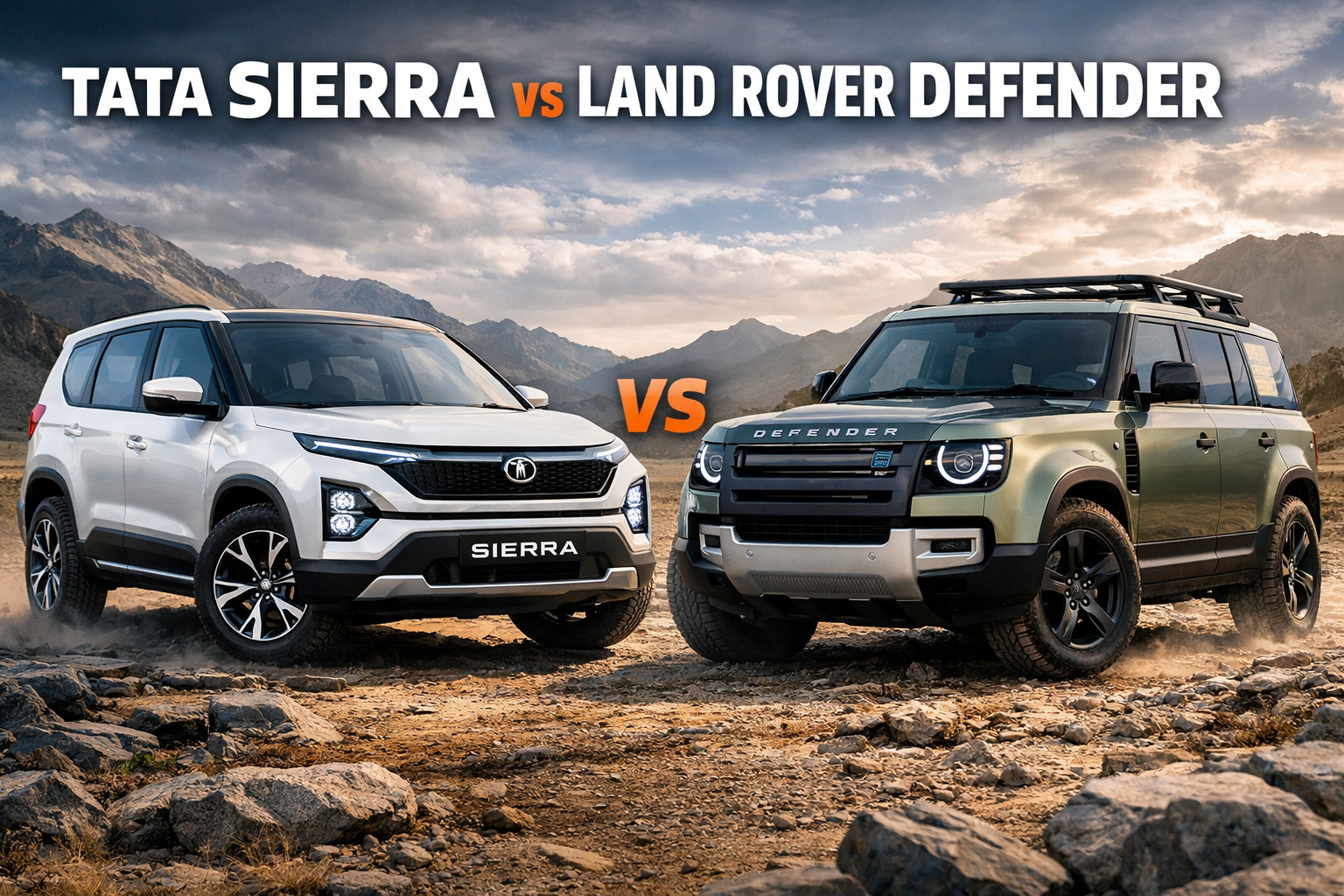
Tata Sierra EV vs. Land Rover Defender: The Ultimate Comparison
| Feature | Tata Sierra.ev (The Indian Icon) | Land Rover Defender (The Global Legend) |
| Category | Modern Electric SUV (Lifestyle) | Luxury Off-Road SUV (Go-Anywhere) |
| Fuel Type | 100% Electric (EV) | Petrol / Diesel / Plug-in Hybrid |
| Design Style | Futuristic, Boxy with Alpine Glass | Rugged, Retro-Modern, Iconic Silhouette |
| Seating Layout | 4-Seater (Lounge) or 5-Seater | 5, 6, or 7-Seater options |
| Off-Road Ability | Mild Off-roading (AWD Expected) | World-Class 4×4 (Terrain Response) |
| Rear Windows | Fixed (Signature Curved Glass) | Traditional (Can be opened) |
| Tech & Screen | Dual-Screen Setup (Tata UI) | Pivi Pro Infotainment (Very Smooth) |
| Build Material | High-Strength Steel (Acti.ev Platform) | All-Aluminum D7x Architecture |
| Wheels Size | 18 or 19-inch Alloy Wheels | 18 to 22-inch options |
| Safety Features | ADAS Level 2, 6 Airbags (Targeting 5-Star) | ADAS, Matrix LED, 3D Surround Camera |
| Maintenance | Low (Electric motors need less care) | High (Luxury parts & complex engine) |
| Target Audience | Urban Professionals & Tech Lovers | Adventure Seekers & Luxury Buyers |
| Price (Approx) | ₹25 Lakh – ₹32 Lakh (Budget Friendly) | ₹95 Lakh – ₹2.5 Crore (Prem |